War Letters – Borneo: 16 Aug 1945, Morotai; Draft copy for Women’s Weekly story

The follwing copy, written whilst in Morotai was the basis for a story published in The Australian Women’s Weekly: 1945 ‘Soldiers in North talk and dream of home.’, The Australian Women’s Weekly (1933 – 1982), 8 September, p.17, http://nla.gov.au/nla.news-article47246573

Wep's War Correspondent badges and sketch book

Morotai, Thursday 16th August [1945]

It was pretty certain on Friday the 10th of August that the war was over. But the wild exuberant lead that flew around to celebrate the peace was just as vicious as that of war. Ironically, peace too, brought its casualties. The spontaneous rattle of machine guns and rifles was answered by the bopping of the Bofors and the slicing of the searchlight batons beating time across the sky. But the tension was gone and there was singing and drinking and yelpings of joy. And there was sentimentality galore. Three days it lasted. By Monday the boys had steamed right off and official peace was accorded no more than just a passing nod. In the night a few tracer shells moved in slow red perforations across the night and no one cared. It was more important and more depressing to contemplate the months yet to be served before demobilisation became for each a real returning to the ways of peace. Things were normal then on Monday. The hangovers were lifting and the cooks just cooked while batmen batted. In the evening at the pictures I attended, the troops stoically accepted the acrobatic antics of warrior Errol Flynn. The ceremonial tracers and searchlights moved on. The Australian Comforts Fund came good with a hamper for each and the thousands of plum-puddings are waiting on the spoon. Jube-jubes, peanuts, and peaches for the boys. A free bottle of beer has been promised.

But after all the shouting the life and background for most of the army personnel is still the same. The jungle is still green and thick and the Celebes Sea is just as ever.

Over there in Northwest Borneo the country is still smothered with gross fat trees in all shapes and sizes. You backyard fernery folk would still goggle at the orchids, creepers, staghorns, and palms – herringbone ferns and bracken like you have at home, but taller than a man!

Thanks to the zestful bombing of the RAAF and to the shelling by the navy, all the shopping centres of all the towns and villages have gone with the wind. One can only surmise what must have been the beauty of pre-bombardment Victoria Town on Labuan Island. The fragments of pale blue plastered walls, the heaps of bright red bricks and tiles, the remains of Chinese architectural devices, the broken retaining walls of the canal behind the shops, the gaunt and shattered trees, the only two surviving brick buildings, the isolated clock tower, an aloof and well-proportioned symbol of the town remain to testify to its one-time charm. What is left is just a ghost. The bricks and bones that were once its substance have been bulldozed off and used as filling on the airstrip. Victoria Town is buried there.

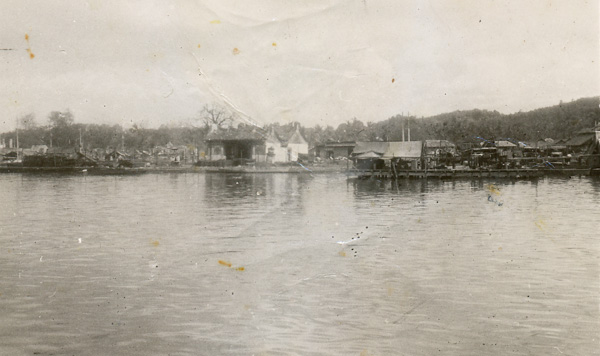
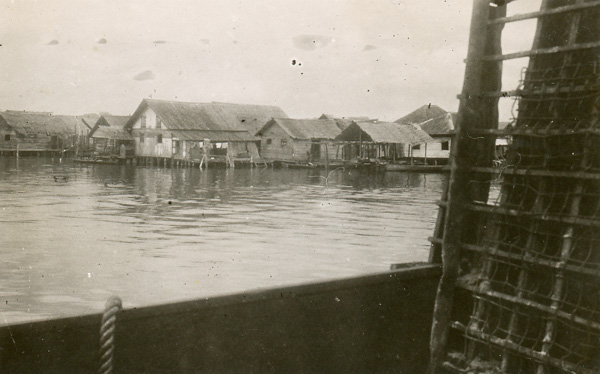
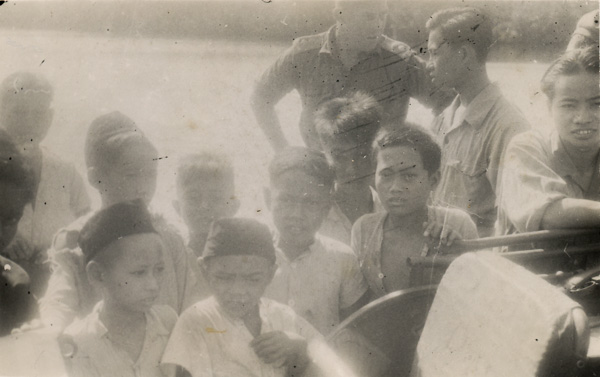
It is a tedious four and a half hours journey by landing craft to Brunei, your doldrums unrelieved by the sight of anything of interest and intensified by the down pouring blast of the Borneo sun. Heaven help Venice if Brunei is, as some allege, “The Venice of the East”. Only a real estate agent could have thought that one up for such a squalid grey collection of native houses. They squat weakly on their legs over the evil-smelling mudflats of the stream. Certainly there is a touch of carnival in the comings and goings of the children in their praus, and in their singing, – high pitched notes that float smoothly on the river and the ooze. Tatter clothed natives pick and scratch in the rubble of the town.

Surprisingly the road to Tutong bursts into twin concrete strips like tracks into a suburban villa garage. The interminable bowing and saluting of the natives is a hangover from the rigourous Japanese domination. Every thatched hut has more than its quota of sparkling little nippers, mostly nude, who wave and salute like their elders. From the more knowing you get thumbs-up and victory signs.

The road loses itself on the beach and the beach becomes the road. The China Sea swishes on the beach and the breeze is cool. A continuous line of casuarinas encroaches on the sand and reminds the boys of home.

Far ahead the smoke of the burning oil wells of Seria throws up the dull blue shape of an apparent mountain range. Closer, the sky darkens and the wind is quiet in the ominous gloom cast by the rolling smoke that dims the sun to the ignominy of a mothball hanging in the murk. Great jets of flame roar like Gargantuan blowlamps, the earth rumbles, and the trees are smothered in soot and oil. It is a black and white photo with fires in the middle. Australian army engineers are putting them out.

Personnel of the 20th Bgde. live a smooth existence at Kuala Belait. Here they share such terrors of war as laid-on gas and water, cricket and swimming on the beach, and offices, reading rooms, and a ping-pong in the homes and clubs of the pre-war oil executives. “A great war”, they used to say, but they’re pleased to see it over. The entrance to the erstwhile market is nice and handily flanked on one side by the local jail and on the other by a notice board bearing dire Army proclamations in English, Chinese and Malay. A few blackened beams and the fire-blued skeletons of a thousand bikes form this cemetery of a street. Malays and Chinese still shuffle up and down the road, or sit passively in the shade to watch the kids play and screech just as they do in Redfern or Fitzroy. In front of three tired shops – the only ones left – tiny silver fish are drying on sheets of corrugated iron in the sun.

From a house comes the brittle tinkling of an untuned piano; someone is playing with one or two fingers a Chinese song which strangely lapses into a few bars of “Way Down upon the Swanee River”. If you get to know little Peggy Ho and you ask her nicely, she will sing in her sweet little voice “I’ll always call you Sweetheart”. She is only 12 and very tiny and in some way her performance is very touching and it makes you think of all the children and of home. Peggy learnt that song and a few others while the Japs were here and when to speak English at all was indeed dangerous. Before they came she knew only her ABC and her family and friends have secretly taught her so much. What could the Japanese do with people like that?

You go to Limbang by barge through twisting aisles of water palms and mangroves. The silence is broken only by the roar of the engines and the monotony of the scene is varied by the appearance of an occasional prau which slides past and is left dancing on the wash behind. The paddlers in their conical straw hats disappear around the bend.

Limbang is the country of the Dyak. He is a real native of Borneo! You are conscious of a shock – your preconceived ideas of him were sadly naïve. Are these exquisitely feminine looking beings the bogeymen of your childhood days? It is unbelievable. Beautifully proportioned, sleek as a pear, you must admire their bodies. Here are Grecian marbles modelled in miniature and clothed in flesh of the lightest coffee hue and tattooed with the green scrolls and mystic patterns on the throat & shoulders. Their long hair is tied up with a strip of coloured cloth and the sun shines bluish on the fringe across the forehead and on the loopings of the spiral pointed bun. Throat bands, armlets, silver bangles just above the calf, and a loin cloth cunningly tied complete the peaceful ornamentation. But their swords and spears are razor sharp, their blowpipes silent and deadly. Many a Jap straggler’s head has been lopped and smoked for their mantelpieces at home. A useful ally to have even if he is not, patrolmen will say, so blooming hot in an open fight.

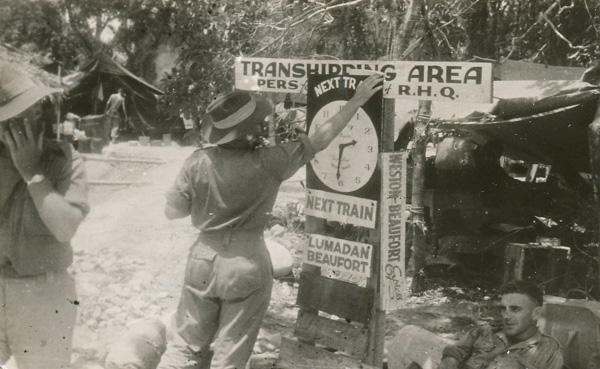
From Labuan another four and a half hours of sitting on a barge like a redhot waffle iron will bring you to the area occupied by the 24th Bgde. This is the land of the celebrated jeep train. Steam engines used to haul the train from Weston to Jesselton but on their hurried way out the Nips did their best to incapacitate the locomotives and the RAAF filled the boilers full of holes. So the engineers put iron tyres on the jeeps and shoved them on the rails and hooked the trucks behind.

The light narrow gauge line leads the train through disused paddy fields, through long and delightful tunnels of tropical green. The rubber trees meet in an arch overhead and the undergrowth, unhindered for the last three and a half years, forms walls of fern and palm and lasiandra whose purple flowers brush your body as you pass. For long stretches the track is carpeted with grass and only the polished rails indicate the way ahead. An intimate green pathway over which trucks clunkety-clunk and we lack only the great asthmatic puffing of the real thing. Natives stand aside for us to pass at intermittent clusters of houses, or at a real station, we disgorge bodies and rations to the babble of the Chinese and Malays.

At Beaufort the army put on a carnival day for the children of the district. The natives swarmed in by train, in boxcars and flat-tops. They squatted and huddled together tight as a bunch of grapes and quietly soaked in the drenching rain. In the boxcars native orchestras “gave out” and were “in the groove” in several different tunes. The penetrating boom of the gongs and the light melodic harmony of the gamelins (a xylophonic saucepan affair) burrowed through the dusk and rain. It was a great day for Beaufort. The children laughed at the soldiers and the soldiers laughed at the natives. Pillow fights and obstacle races, lolly-water and fireworks, Malay dances and Chinese singing, jeep rides, speeches and fraternisation, Miss Beaufort competition and ceremonial tea drinking – it was all there. British administrators considered with gloomy foreboding the Australian “spoiling of the native”. At 11.30 p.m. they straggled home – grandpas, grandmas, dads, and mums with sleeping kids swung in “cuddle seats” made of gaily coloured scarves.

There is nothing more to say. In all the talk of Borneo it is only home, and how quick the five-year men can get there that matters. This is THE topic, whether with the boys on patrol, or with the wallahs at the base. Points scores and probabilities of departure times are studied and discussed like form guides, And it shouldn’t be long before many homes have their men back for good.

(Alternate paragraph on different paper)

Of all the talk in Borneo it was, and still is, only home and how quickly the men can get there that matters. This is THE topic, with both the boys up front and the wallahs at the base.

Naturally five-year men will be first and points scores and probabilities of departure times are studied and discussed like form guides. News of the POWs of the Eight Div. Is expected hourly and the long awaited reunion with them is imminent.

Yes. Very soon many homes will have their men return for good.

War Letters – Borneo: 3 Aug 1945, Weston; Jeep train to Beaufort

W. E. Pidgeon
c/o Public Relations
1 Aust Corps
3 Aug Friday [1945]


Dear Jesso,

Am in a stinking little grey bleached place called Weston – arrived here after 4 1/2 hours in another barge and the trip was just as hot and dull as that from Brunei.  Soft lotions of frankiness and myrth would be more beneficial to my skin than these down pouring blasts of heat.  Yesterday in Labuan we took a day off and lazed in the sun and surf and under the coconut palms while the China Sea sent sweet cooling winds to dry away the sweats.  It seemed so cool, although it was 87 degrees (symbol) in the shade of the tents that Cliff and I just sopped up sun in a big way.  Half an hour after retiring to the tent I took on a particularly choice hue of Alizarin Crimson which makes a very striking colour combination in juxtaposition to my green shirt, and makes for a very tender shoulder, not the sort of shoulder on which to sling the many and weighty packs I am lugging around.  We got up at 5.30 this morning, and waited till 8.15 for the barge to pull out.  Of course this barge must miss contact with the 12.00 jeep train that runs from here to Beaufort.  So we are waiting again.  Just a mere 2 hours for the next.  2 hours as lively as one could wish for – just as if you were on one of those unattended railway stations out west.  This jeep train is, I believe, as I haven’t yet seen it, a collection of motley old carriages and trucks pulled along a light narrow gauged line by a jeep which has had its ordinary wheels replaced by a railway type.  Weston is a hive of activity – three natives just staggered past.

Beaufort 8.30 pm.  So far this is a bastard of a place.  After a really stinking day we have been unloaded into an old evacuated house to which clings a rare odour of old Chinese or Japs.  (At least that is what I presume that is what it is).  To cap matters there’s no even a bleeding light in the whole flaming joint.  Consequently I’m writing this in a Salvation Army social tent housing at the moment 25 lively tea drinkers and one cud-chewer which is me.  The tables groan under the weight of many cuppas (or rather tinnas), the conversation is subdued but constant – the radio more than holds its own against all other noise.  Four other diligent letter writers compete with my silence.  It’s all very much like the lounge of an hotel only the liquor is tea (or whatever it may be – I am completely baffled by the taste) and the only occupants naturally are men.  It is quietly social.  And is the only place wherein I can find light enough to write this letter.  Incidentally I am the only baldy in the place, and for that matter one of the few I meet in the whole army under the rank of Colonel or Brigadier.  Nevertheless the fruitful climate of Borneo has brought forth on any arid head a fine crop of 4 or 5 brand new hairs.  These grow straight and bravely upright down the centre of  the field.  My continuity of thought is breaking down under the strain of trying to hear what everyone is saying.  The tea is evidentially encouraging them to compete with the volume of the wireless – the general level of noise has risen by 100 percent.  I think I’ll have another go at the brew that is coming out now – it seems to have some stimulating virtues from what I can here.  It’s hot and wet – it tastes sweet and has a dark cloudy look  – but I still don’t know what it is.

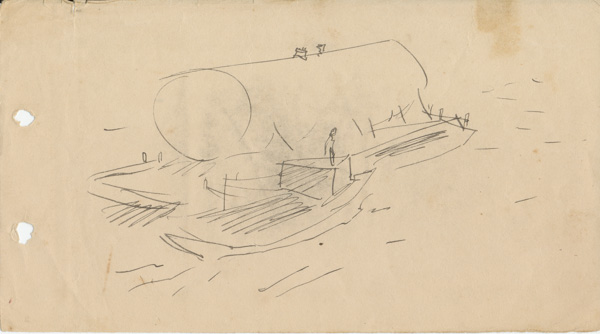
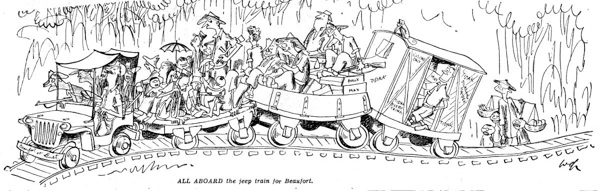
The jeep train was worth the trip even if there is little in it as a serious drawing job.  Perhaps a comic sketch.  The steam engines which used to draw the trucks and carriages have broken down and are under repair.  The ubiquitous jeep takes their place and draws up to 3 cars behind them. The one we came up on consisted of first a flat top truck, next an ordinary one, and lastly a box car for the rations.  Chinese and Malays occupied the first, and soldiers the second.

jeep train

It is an interesting trip.  The narrow gauge leads the train by disused paddy fields through long and delightful tunnels of tropical green.  The rubber trees meet in an arch overhead and the undergrowth that has been growing in the plantations for the last 3 1/2 years forms walls of fern and palm and flowering lasiandra which brush the body as you pass.  As a rule the track itself is carpeted in grass and only the polished lines indicate the way ahead.  An intimate green pathway over which our trucks clunkety – clunk with all the noises save that of the great asthmatic huffing of a real train.  Natives stand aside for us to pass and look just like the line people back home – but you miss the cry of “Paper! Paper!” At occasional clusters of houses in the plantations we pull up at a station and unload to the screechings and joviality’s of the Chinese.  I shall continue the train trip further onto Papar in a few days time.

Am looking forward to getting a letter in a few days.  I hope that you are both all right – also Mum.  How’s the pool and fitties?  Have you been giving the Coyes a rest.  I am feeling very holy and very well – don’t care if I don’t have a drink at all and certainly have no desire to collect myself any more hangovers.

Lots of love dear – tell little Graham Poppa thinks often of him always when I see the kids up here and there are thousands of them.

Love

Bill

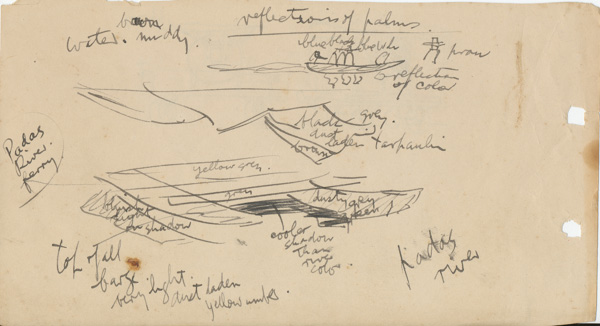
Possibly along the Padas River near Weston, Borneo
Padas River Ferry
Padas River Ferry
Possibly along the Padas River near Weston, Borneo
Padas River Ferry
Padas River Ferry
Padas River Ferry
Padas River Ferry
Padas River Ferry
Padas River Ferry
Padas River Ferry
Padas River Ferry
Padas River Ferry
Padas River Ferry
Padas River Ferry
Padas River Ferry
Rail carriages used by the Jeep Train
Along the Jeep Train line between Weston and Papar
AWW 1945-09-08 p17 Jeep Train - Copy
All aboard the jeep train for Beaufort, The Australian Women’s Weekly, 8 Sep 1945, p17

Caravanning with Wep – Wednesday, 26th May 1937; Settling in at Jindabyne & scouting locations to paint.

 26th May.

Been here a week now. Liking it much better. Fine painting here. Could stay months. Have become acclimatised to the colour so to speak. Personally prefer the washed out hues to those multitudinous greens of Kurrajong. Went wrong over a painting of the River. Guess it’s not nearly what I wanted. Am getting along better with a sketch of a drab road, drab fence and drab rocks – and the persistent intense blue of the sky. Hope it turns out alright.

Paid a visit to Hotel Kosciusko & passed time of day with the Speets. Had afternoon tea of all things! Not a bit of blarsted snow within miles – which is a nice kettle of fish! Can even get to the Chalet per car! How horrible! But, by Heavens, I’ll get some skiing before we go – or else!

Brought firewood back with us. Dawnie got two pieces bless her little heart.

Pretty cold here the first few days but summered up beautifully over the week end when the Cooma crowd paid us a visit. Sunk quite a few empties with gun fire.

Unsuccessfully attempted to wade the river but saw a TROUT.

Knocked the b….. lamp on the floor and smashed it.  Smashed 2 mugs, all the glasses and 1 cup and 2 saucers and 1 plate.  So got rid of that damned Crown piece I was keeping for luck. Haven’t had any since we got it.

What a town!  Can’t get this, can’t get that! Half the time the butcher’s shut. You can’t get eggs, or vegetables. Live on dried peas, potatoes, pumpkin, and Swedes. Fruit 1½d a piece, tomatoes 10d lb! Beans happened once at 9d lb.

Get raffle tickets though for a fat sheep & supper cloth. But then what the heck’s the good of a fat sheep to me? As for getting milk! May as well ask for Manna! However found out at Koscy that could get milk over the road from where we are staying. At Johnny Weston’s. Simple. Just trudge a mile or so up hills, through a creek, etc. But get about ½ gallon for 6d. And drink the bloody lot!

Am getting quite blubbery. Have never seen a place with so many bones and gizzards splodged about. Huge belly bags full of grass, dismembered cattle feet, decapitated heads skin tripped and closed-eyed. Cow bones, sheep bones, skulls, hooves, horns, & bowels. And buckets of blood for the geese & things.  All garnished with the rusted up sided skeletons of two cars. A veritable Golgotha. Motherly cows attending two weeks calves. Poor Johnny, to keep his beef cows milk up to scratch bought 5 jerseys & all are lousy teated. Too this & too that. No can milk much.

Cold enough to freeze the —— off a brass monkey this morning. Be better off sleeping in a Frigidaire. And the make shift double bed would collapse – of course! And we shiver and shake at 4am fixing it. UGH!

Have morning tea with 1 lump of sugar and 2 lumps of milk. Everything in the caravan frozen. Ice in the billy & solid milk in the jug. The roof and windows inside hoary with frost. Nose, near frozen off. Kept the bald spot warm though, by cripes. Outside all was white as though snow covered. The edges & pools alongside the river iced over. Briars icy –stubbed. Dawnie frozen, shivers. Much action, excitement eating, drinking & yodelling from me.

But I’m dressing up to go to bed tonight. No more half-sleep from 2:30am onwards. Me for warmth even if I have to put the over coat, long underpants & skiing socks on.

Days are too short for work here. By the time I thaw out its 11 o’clock. Get in 2 hours & it’s lunch. Supplied with food until 2:30. Thence till sundown – 5 o’clock. & the wind gives us the works. Marrow-freezing. BR-R-R!

Went back to Weston’s today. Struck the best gloom spot yet. A dull raw day. An aged wood fence surrounds a tired grey sheep shed whose stone foundations drip tiredly away from buttered joists. Great gaps show desolate as a front toothless mouth. Close packed, winter wind tortured trees, long since bereft of life twist their melancholy limbs into shapes now sinuous, now harshly jagged, speaking both of living pain and aching death. Throughout the grey and blackened twig lacery crows craa harshly and incessantly and wing blackly against the liquid tear eyed sun.

Uplifting limbs protest their doom and the scavengers flap dismally through the dropping bones. Harsh and discordant they sing a requiem CRAA – CRAA – CRAA.

But beauty yet transcends their death and frames for us a pattern of their once proud vitality and rhythm. Their bones, patterned individually upon their life reveals them us and leaves a fading concretisation of a will to live.

A fine spot and the day to meet it, cold, blue, pregnant with negation & death.

Found a standing trunk 6’ high from out of which an incipient adolescent human form spring. I returned with axe & chisel and with endeavour to help it escape the bonds of surplus wood. This place of frozen souls. Reincarnations. Every tree a mirror of some human soul. No dead place this but a spot full of hope – full of supplication for release. Ground tied awaiting the artist to seek their inner being, their essential themselves, and free them of their own redundancies. The life that’s in those bones! I have found a temple.

error: Content is protected !!