War Letters – Borneo: 17 Aug 1945, Morotai; Overnight stop in Zamboanga, The Phillipines

W. E. Pidgeon
c/o Public Relations
1st Aust Corps
17th August [1945]
Friday
Morotai

Darling,

There are us – no signs of my departure.  I’m just sitting in the sun in a state of vaporisation (?).  Yesterday I rewrote because of the Peace, the introduction to a story from the “Women’s Weekly” and did another black and white sketch to go with it.  They should be at the office on Monday morning but I don’t (know) whether that is time enough to get it in the edition in which it will not be too cold.

Apparently Sydney made fair sort of whoopee during the past week.  I hope you kept an even balance and  haven’t dropped young Graham on his head or anything.  God knows if I’ll be home before our Anniversary.  I hope so.  But the transport position is really frightening.

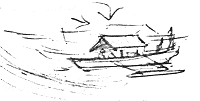
On the way from Labuan to Morotai we stayed overnight at Zamboanga, third largest town in the Phillipines.  It is situated on the extreme southern tip of the most southern of the islands.  A good deal of it was knocked about but it was still the most interesting place we have struck.  Cliff Eager, Capt. Flett (an official war artist from Melbourne) and I walked into the town from the airstrip and gave it a good smelling over.  What a stinking, dirty, filthy lot most of the Phillipinos are!  The women dress in ill fitting and bedraggled European clothes and they are fat and slothenly.  Not a patch on the Malays or the Chinese for carriage and looks.  They seem to be a pretty degenerate lot – in Zamboanga at least.  The waterfront looks much as it does in photos of other eastern ports.  Hundreds of watercraft with  little roofs built over the vessel and with outriggers on both sides like

Image19

A concrete promenade with steps into the water is absolutely littered with refuse the stench of which is abominable.  Fruit skins, dead fish, sweat, every ruddy thing.  The native village on stilts in mid stream would make you sick!

The cost of living is terrific!  Only 2 Pesos to the American dollar – which makes one Peso worth 3/1 Australian.  The three of us had a cup of tea and one ordinary chicken sandwich in the cleanest looking shop in town.  This set us back only 5 Pesos 40 cents = 16/-!

Anyway, we dawdled around a bit more & decided to have tea at the same place.  We had a really good chinese feed for the modest figure of 11 Pesos 50 cents.  Thank heavens we didn’t stay there long.  Arrived in Morotai on Tuesday 12 noon.  I don’t feel much like writing.  I’d rather be getting back to see you & tell you all about everything and to see how the little man is doing.  I wonder if he’ll remember me.  I suppose not.  Lots of love darling – please look after yourself.

Bill

P.S. I got your second letter at Labuan just before I left.  Have had none since.

W.E. Pidgeon (WEP) watches a performance of Jiu-Jitsu with Japan
JAPANESE PRISONERS OF WAR at an Australian compound on Morotai watch an exhibition of judo (a form of jiu-jitsu). With them (top right) is Daily Telegraph artist “WEP”. – Australian official photo, published, The Daily Telegraph, 1 Sep 1945.

[This would appear to have been Bill’s last letter home to Jess. His exact return date is as yet unknown but it is anticipated he did make it home in time for his and Jess’s 12th wedding anniversary on August 24th, 1945.]

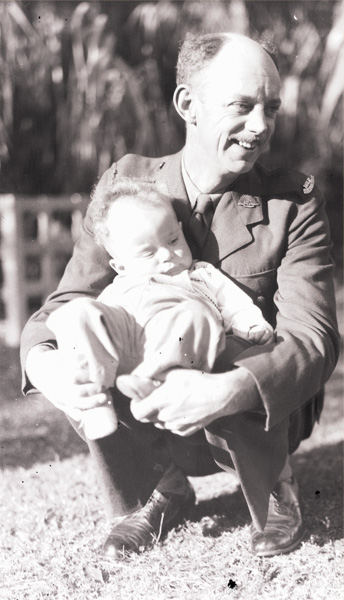
W.E. Pidgeon (WEP) with son Graham at home in Northwood about Ja
W.E. Pidgeon (WEP) with son Graham at home in Northwood, Sydney
WEP_JESS_018 Jess, Graham and Bill circa 1945
Jess, Graham and Bill Pidgeon (Wep) at home in Northwood

War Letters – Borneo: 16 Aug 1945, Morotai; Draft copy for Women’s Weekly story

The follwing copy, written whilst in Morotai was the basis for a story published in The Australian Women’s Weekly: 1945 ‘Soldiers in North talk and dream of home.’, The Australian Women’s Weekly (1933 – 1982), 8 September, p.17, http://nla.gov.au/nla.news-article47246573

Wep's War Correspondent badges and sketch book

Morotai, Thursday 16th August [1945]

It was pretty certain on Friday the 10th of August that the war was over. But the wild exuberant lead that flew around to celebrate the peace was just as vicious as that of war. Ironically, peace too, brought its casualties. The spontaneous rattle of machine guns and rifles was answered by the bopping of the Bofors and the slicing of the searchlight batons beating time across the sky. But the tension was gone and there was singing and drinking and yelpings of joy. And there was sentimentality galore. Three days it lasted. By Monday the boys had steamed right off and official peace was accorded no more than just a passing nod. In the night a few tracer shells moved in slow red perforations across the night and no one cared. It was more important and more depressing to contemplate the months yet to be served before demobilisation became for each a real returning to the ways of peace. Things were normal then on Monday. The hangovers were lifting and the cooks just cooked while batmen batted. In the evening at the pictures I attended, the troops stoically accepted the acrobatic antics of warrior Errol Flynn. The ceremonial tracers and searchlights moved on. The Australian Comforts Fund came good with a hamper for each and the thousands of plum-puddings are waiting on the spoon. Jube-jubes, peanuts, and peaches for the boys. A free bottle of beer has been promised.

But after all the shouting the life and background for most of the army personnel is still the same. The jungle is still green and thick and the Celebes Sea is just as ever.

Over there in Northwest Borneo the country is still smothered with gross fat trees in all shapes and sizes. You backyard fernery folk would still goggle at the orchids, creepers, staghorns, and palms – herringbone ferns and bracken like you have at home, but taller than a man!

Thanks to the zestful bombing of the RAAF and to the shelling by the navy, all the shopping centres of all the towns and villages have gone with the wind. One can only surmise what must have been the beauty of pre-bombardment Victoria Town on Labuan Island. The fragments of pale blue plastered walls, the heaps of bright red bricks and tiles, the remains of Chinese architectural devices, the broken retaining walls of the canal behind the shops, the gaunt and shattered trees, the only two surviving brick buildings, the isolated clock tower, an aloof and well-proportioned symbol of the town remain to testify to its one-time charm. What is left is just a ghost. The bricks and bones that were once its substance have been bulldozed off and used as filling on the airstrip. Victoria Town is buried there.

It is a tedious four and a half hours journey by landing craft to Brunei, your doldrums unrelieved by the sight of anything of interest and intensified by the down pouring blast of the Borneo sun. Heaven help Venice if Brunei is, as some allege, “The Venice of the East”. Only a real estate agent could have thought that one up for such a squalid grey collection of native houses. They squat weakly on their legs over the evil-smelling mudflats of the stream. Certainly there is a touch of carnival in the comings and goings of the children in their praus, and in their singing, – high pitched notes that float smoothly on the river and the ooze. Tatter clothed natives pick and scratch in the rubble of the town.

Surprisingly the road to Tutong bursts into twin concrete strips like tracks into a suburban villa garage. The interminable bowing and saluting of the natives is a hangover from the rigourous Japanese domination. Every thatched hut has more than its quota of sparkling little nippers, mostly nude, who wave and salute like their elders. From the more knowing you get thumbs-up and victory signs.

The road loses itself on the beach and the beach becomes the road. The China Sea swishes on the beach and the breeze is cool. A continuous line of casuarinas encroaches on the sand and reminds the boys of home.

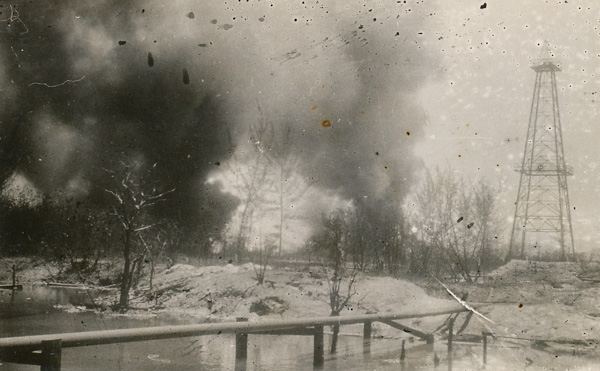
Far ahead the smoke of the burning oil wells of Seria throws up the dull blue shape of an apparent mountain range. Closer, the sky darkens and the wind is quiet in the ominous gloom cast by the rolling smoke that dims the sun to the ignominy of a mothball hanging in the murk. Great jets of flame roar like Gargantuan blowlamps, the earth rumbles, and the trees are smothered in soot and oil. It is a black and white photo with fires in the middle. Australian army engineers are putting them out.

Personnel of the 20th Bgde. live a smooth existence at Kuala Belait. Here they share such terrors of war as laid-on gas and water, cricket and swimming on the beach, and offices, reading rooms, and a ping-pong in the homes and clubs of the pre-war oil executives. “A great war”, they used to say, but they’re pleased to see it over. The entrance to the erstwhile market is nice and handily flanked on one side by the local jail and on the other by a notice board bearing dire Army proclamations in English, Chinese and Malay. A few blackened beams and the fire-blued skeletons of a thousand bikes form this cemetery of a street. Malays and Chinese still shuffle up and down the road, or sit passively in the shade to watch the kids play and screech just as they do in Redfern or Fitzroy. In front of three tired shops – the only ones left – tiny silver fish are drying on sheets of corrugated iron in the sun.

From a house comes the brittle tinkling of an untuned piano; someone is playing with one or two fingers a Chinese song which strangely lapses into a few bars of “Way Down upon the Swanee River”. If you get to know little Peggy Ho and you ask her nicely, she will sing in her sweet little voice “I’ll always call you Sweetheart”. She is only 12 and very tiny and in some way her performance is very touching and it makes you think of all the children and of home. Peggy learnt that song and a few others while the Japs were here and when to speak English at all was indeed dangerous. Before they came she knew only her ABC and her family and friends have secretly taught her so much. What could the Japanese do with people like that?

You go to Limbang by barge through twisting aisles of water palms and mangroves. The silence is broken only by the roar of the engines and the monotony of the scene is varied by the appearance of an occasional prau which slides past and is left dancing on the wash behind. The paddlers in their conical straw hats disappear around the bend.

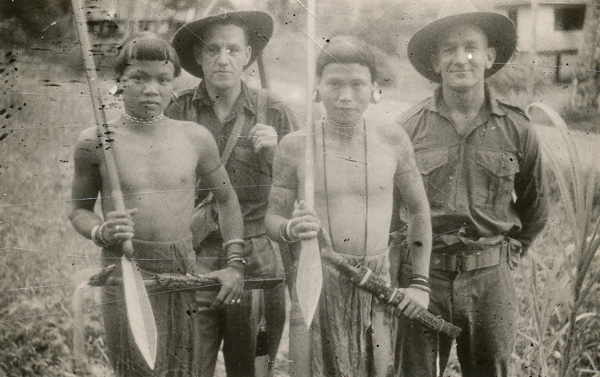
Limbang is the country of the Dyak. He is a real native of Borneo! You are conscious of a shock – your preconceived ideas of him were sadly naïve. Are these exquisitely feminine looking beings the bogeymen of your childhood days? It is unbelievable. Beautifully proportioned, sleek as a pear, you must admire their bodies. Here are Grecian marbles modelled in miniature and clothed in flesh of the lightest coffee hue and tattooed with the green scrolls and mystic patterns on the throat & shoulders. Their long hair is tied up with a strip of coloured cloth and the sun shines bluish on the fringe across the forehead and on the loopings of the spiral pointed bun. Throat bands, armlets, silver bangles just above the calf, and a loin cloth cunningly tied complete the peaceful ornamentation. But their swords and spears are razor sharp, their blowpipes silent and deadly. Many a Jap straggler’s head has been lopped and smoked for their mantelpieces at home. A useful ally to have even if he is not, patrolmen will say, so blooming hot in an open fight.

From Labuan another four and a half hours of sitting on a barge like a redhot waffle iron will bring you to the area occupied by the 24th Bgde. This is the land of the celebrated jeep train. Steam engines used to haul the train from Weston to Jesselton but on their hurried way out the Nips did their best to incapacitate the locomotives and the RAAF filled the boilers full of holes. So the engineers put iron tyres on the jeeps and shoved them on the rails and hooked the trucks behind.

The light narrow gauge line leads the train through disused paddy fields, through long and delightful tunnels of tropical green. The rubber trees meet in an arch overhead and the undergrowth, unhindered for the last three and a half years, forms walls of fern and palm and lasiandra whose purple flowers brush your body as you pass. For long stretches the track is carpeted with grass and only the polished rails indicate the way ahead. An intimate green pathway over which trucks clunkety-clunk and we lack only the great asthmatic puffing of the real thing. Natives stand aside for us to pass at intermittent clusters of houses, or at a real station, we disgorge bodies and rations to the babble of the Chinese and Malays.

At Beaufort the army put on a carnival day for the children of the district. The natives swarmed in by train, in boxcars and flat-tops. They squatted and huddled together tight as a bunch of grapes and quietly soaked in the drenching rain. In the boxcars native orchestras “gave out” and were “in the groove” in several different tunes. The penetrating boom of the gongs and the light melodic harmony of the gamelins (a xylophonic saucepan affair) burrowed through the dusk and rain. It was a great day for Beaufort. The children laughed at the soldiers and the soldiers laughed at the natives. Pillow fights and obstacle races, lolly-water and fireworks, Malay dances and Chinese singing, jeep rides, speeches and fraternisation, Miss Beaufort competition and ceremonial tea drinking – it was all there. British administrators considered with gloomy foreboding the Australian “spoiling of the native”. At 11.30 p.m. they straggled home – grandpas, grandmas, dads, and mums with sleeping kids swung in “cuddle seats” made of gaily coloured scarves.

There is nothing more to say. In all the talk of Borneo it is only home, and how quick the five-year men can get there that matters. This is THE topic, whether with the boys on patrol, or with the wallahs at the base. Points scores and probabilities of departure times are studied and discussed like form guides, And it shouldn’t be long before many homes have their men back for good.

(Alternate paragraph on different paper)

Of all the talk in Borneo it was, and still is, only home and how quickly the men can get there that matters. This is THE topic, with both the boys up front and the wallahs at the base.

Naturally five-year men will be first and points scores and probabilities of departure times are studied and discussed like form guides. News of the POWs of the Eight Div. Is expected hourly and the long awaited reunion with them is imminent.

Yes. Very soon many homes will have their men return for good.

War Letters – Borneo: 10-11 Aug 1945, Labuan; Peace rumours & concerns about getting home

W. E. Pidgeon
c/o Public Relations
1 Aust Corps
Labuan
Friday 9th August
[10 Aug 1945]

I have vowed to let my mo grow till I get home – damn it!

Image17

Darling,

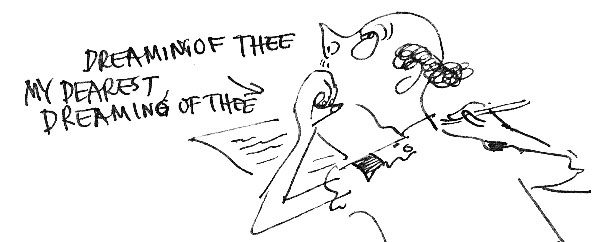
Am back on this island & it looks as if I’ll be bloody well marooned here.  Transport in seems incredibly easier to get than transport out.  Everyone so far as I can see have been sitting on their behinds for days waiting the call for the trip back.  Cliff is on his way back i.e. theoretically but he is still here giving the old spine a bash.  I’ve only been here 2 days but I had requested an arrangement to get me to Balik Papan four or five days ago.

Saturday.  The ink ran out of my pen last night.  So I took the knock on letter writing.  Seems as you have done so too.  I’ve had only one letter since I left Sydney.  Last night the great peace rumours came through and there was a great simmering undercurrent of excitement and supposition amongst the army personnel.  The correspondents saw the probabilities of considerable hold up in transport home and were appropriately apprehensive.  I think the best thing I can do is to come back with what stuff I have rather than spend so much more time waiting for travel to Balik Papan and probably waiting for it from there home.  I should imagine that all the work I could collect down there will be pretty cold fish by the time it gets in the paper if peace is officially announced within the next few days.  I really don’t know what would be the best thing to do as I am not likely to hear from the office for days even if they had the nouce to send a message at all.

Later – have decided to definitely return home as soon as possible.  It is now just a matter of waiting and I suppose it will at least be somewhere near the 20th till I can get there but all this means that I will be at least present on the 24th so behave yo’self and save the grog.  Mail comes in here only three times a week so maybe I was somewhat hasty in my screamings out for letters.  Another mail is due in tomorrow.  You can tell Ivan I met Syd Newman – since this Visitor’s and Observers’ Camp has been moved to the opposite side.  Off the island we have become practically neighbours.  Newman was pleased to hear from Ivan and he obviously thinks a lot of him.

Everyone here expects the official peace announcement at any moment.  Nevertheless there is no excitement.  The everyday routine is still going on as if nothing is happening – which is reasonable enough as the finish will make little immediate change in the status of most of the troops here.  They will obviously have to stay for some time – to collect prisoners, police the country, and control the gradual disbandment of the army.

I am anxious to hear more about you and Graham.  How’s that alleged tooth coming along?  I suppose he is on pretty hard tack now.  I hope he is eating something that is easy to give him.  You’d better save some meat coupons for some juicy steak and eggs for poor lean Will.  I have had the bully beef and M & V & consequently eat rather lightly.  I seem to have lost a bit of the meat off my mug and to have got rid of my beer gut.  I’ll wire you from my first overnight port of call in Australia.  I’ll phone if I can.  Perhaps I will be home sometime towards the end of next week.  Who knows.  I have finished an article for “The Weekly” but it looks as if I’ll have to redraft it in view of the unexpected developments.  I may as well bring the thing back with me than mail it.  Hope Mum is well.  Lots of love to you and your little bub.

Bill

We spend our days on this St. Helena in slothful annoyance alternating with frolicks in the luke warm China sea and sun baking or reading beneath the coconut palms.  I lost all the skin off my chest and shins thanks to the exuberance of the Borneo sun.

Image18Love Willie

P.S. Don’t write after you get this letter.

War Letters – Borneo: 28 Jul – 2 Aug 1945, Limbang & Labuan; Visit to a Dyak village

W. E. Pidgeon
C/o Public Relations
1 Aust Corps
July 28 Sat. [1945]


Dear Jess,

Will probably be moving off tomorrow for the Jesseltown area which I should manage to cover in a week.  I have 7 or 8 possible subjects up my sleeve now, so what with that trip & a week or ten days at Balik Papan (Bally P ‘parn’ to you, mug).  I should have enough stuff to satisfy “The Weekly”.  I see no good purpose served by just hanging around sight seeing.  What really takes up the time here is transport which is slow & varied.  I intend to visit a Dyak (the indigenous native) village on the way back to Labuan.  I should be home in 4 or 5 weeks.  Am having a loaf this afternoon and shall perhaps take in a swim later.  Spent an extremely hot morning trying to paint a blown up workshop which now houses the field bakery.  Had the usual horde of sightseers clustered around me.  They did not worry me as much as the difficulties encountered in the attempt to paint under the tropical sun.  Sweated like a pig all the morning and am now in a semi coma.  This climate is enervating enough – turns me into a sort of lean Tommy Moon.

Image13

I’d do a shot of spine bashing only that I would be awake half the night!

Tuesday 6 pm.
[31 Jul 1945]

Have just finished a tea of sorts (we have it at 5.30, which is really about 4 o’clock) and am sitting in solitary state in my own tent watching a sudden tropical downpour, complete with thunders & lightenings.  I sit and contemplate the muddy foreground.  The uncountable puddles making it nearly as wet as the Limbang River which flows past just a hundred yards away.  I am not back at Labuan yet although I intent to return there tomorrow.  On the advice of those who know I sidetracked myself to the village of Limbang – a 1 1/2 hours barge run from Brunei.  It was worth the visit alright.  Here one sees the natives of Borneo, the head hunting Dyak, in their real state.

AWW 1945 Oct-20
The Australian Women’s Weekly, 20 Oct 1945

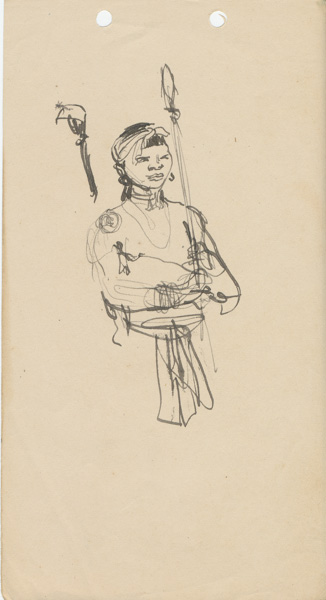
[Study, Dyak warrior, Limbang area, Sarawak I]
[Study, Dyak warrior, Limbang area, Sarawak I]
By God, they’re magnificent people.  It is hard to associate their grace & beauty with their bloodthirstiness.  The extraordinarily feminine features of the young men must be seen to be believed.  They are small but wonderfully proportioned – with their long hair, reaching down to the bottom of their shoulder blades, or done up in a pointed bun at the back.  They wear too a jet black fringe across the forehead and beaded throat bands.  Great big earrings, or rather decorative plugs in their ears.  Silver bangles run riot on their forearms, & above the calf of the leg (a wonderful leg too, me girl!).  Blue green tatooing’s on the throat & shoulders – and a colorful loin cloth sits comfortably alongside the sharpest of swords.  Two of the kids, one about 14, the other about 17 were bloody beautiful.  I shan’t try to draw them for you as I couldn’t do them justice.  I took some photos of them late in the evening – I hope they come out alright.  Chinese & Malays wander up and down the only street all day long.  Some good lookers too, by gum.  The army crimes anyone found indulging in hanky panky with the native population.  The women marry early & have a child every year.  For every couple there must be an average 4 or 5 kids, and this by the time the woman is 22.

Wed. 5 pm

[1 Aug 1945]
Taking a barge to Limbang
Barge at Limbang

Have been sitting reading in the bottom of this barge for Labuan.  Three dreary hours have just passed – the first 2 in a hazy somnolent stupour against my packs and dripping from every pore beneath the sweltering sun.  There is absolutely nothing to look at from the bulwarks above – just the same sea, lazily waving in the same patterns as it did twenty miles back.  In the distance the same casual pale blue line of hills.  We are due to land at Labuan in an hour and a half.  I look forward to the landing at it means getting out of this dreary hot box – and most important – there should be some mail from you darling, awaiting.

Labuan
Thursday
[2 Aug 1945]

Things ain’t just what they should be.  No mail and no transport out of here tomorrow – which means a day wasted in sitting on my rear and grinding my teeth with sheer impotency.

We are in a new camp, a pleasant enough spot under the palms & facing the beach, but miles from any blasted where I could do some work.  Alan Dawes, Smyth, and Adams, are on the way home.  Only Cliff remains.

The only thing to do is to try and get some of the clammy sweat out of my clothes.  I have been getting around too much to be able to get them washed.  Looks like a cold water lick for them this morning.

Mail goes out shortly so bulletin will be cut to short issue.  The boys tell me that the mail has been delayed so I will not go into hysterics yet.  Today 3 weeks since I left Sydney and no news from the home front.

All rather grim not knowing how you & Bub are getting along.

Lots of love

Bill


I wrote a poem of sorts while spine bashing at Kuala Belait.

They are my clothes hanging there
Limp in the Borneo sun
And threaded on a sagging rope.
I can accept the flat green leaves
Gently swaying as the hawk
Who sails above the swish of surf
I can accept the bare chested soldier
His stained fag hanging from his lips
While he ties his singlet on the line
With string
I can accept the drifting mountain cloud
Of rolling oil fire smoke
Which canopies the sea
I can accept the clanking of the pans
The cook without enthusiasm
Washes in the hot and chlorinated water
I can accept the butterfly
Who flutters wavy and but once
Past the tents vee shaped pane of light


Dyak warriors with unidentified War Correspondents at Limbang, B
Dyak warriors with unidentified War Correspondents at Limbang, Borneo (possibly Cliff Eager on left)
Dyak warriors with an unidentified War Correspondent at Limbang,
Dyak warriors with an unidentified War Correspondent at Limbang, Borneo
Dyak warriors, Limbang, Borneo
Dyak natives, Limbang
Dyak warriors, Limbang, Borneo
Headhunters, Dyak warriors, Limbang, Borneo
Dyak warrior. The Dyaks are small in stature with almost feminin
Dyak warrior. The Dyaks are small in stature with almost feminine like features but reknowned for being deadly head-hunters
[Study, Dyak warrior, Limbang area, Sarawak II]
[Study, Dyak warrior, Limbang area, Sarawak II]

21 x 11 cm 21 x 11 cm 21 x 11 cm 24 x 18 cm 21 x 11 cm 21 x 11 cm24 x 18 cm 24 x 18 cm

War Letters – Borneo: 26 July 1945, Seria; Oil wells set on fire during Japanese evacuation

W. E. Pidgeon
c/o Public Relations
Thursday
26th July [1945]


Darling,

Am now on the North East coast of Borneo – still in Brunei protectorate and staying at a place called Seria where the Japs fired the oil wells before evacuation.  These fires are really a sight and  a half.  Hours before you arrive here you can see the smoke billowing into the sky, forming what looks like at  a causal glance a great distant range of hazy mountains.  Closer – the light of the sun is shut out by the smoke and an ominous pall of near darkness and portentous gloom hangs over the jungle.  The fires spout out with a roar like a thousand great blow lamps – the flames, or rather a huge swirling billow of fire twists its way into rolling volumes of thick and pungent smoke.  Am going down this morning to see the boys attempt to put one out.  This is a cert for a “Women’s Weekly” job if the whole business up here is not a cold duck before I finish.


Burning oil wells at Seria

I’m getting a bit worried about that as movement in this area is slow and at times difficult to obtain.  I have yet to go to the northern Brunei area and to Balik Papan.  I think I had best speed things up as much as possible.  The jungle here is much more opulent, sleeker, and fatter in the leaf, and in diversity and colour, than that of New Guinea.  Lasiandra grows like a weed all over the place.  It’s a pretty poor specimen – a meager squirt of the thing compared to the one that I used to grow.  How’s it doing since the great disaster?  Do you keep woman wet?

Haven’t had any letters from you yet, but as I have not expected any I guess no damage is done.  How are things going with you – I hope your mother is not pumping too much food into your petite frame.  Have not seen anything worthwhile bringing home.  I’m afraid the early troops have cleaned out everything of any style or value.

Went down to very well spoken chinese fellow’s home last night.  He was an expert employee of the oil company’s before the Japs came.  He has avoided working for the Nips since their arrival & in secret meetings with other chinese always spoke English & talked of the time they would return.  A little girl [Peggy Ho] about 6 or 7 years of age sang “I’ll always call you sweetheart” tunefully & in extremely good English.  I remember well the last time I heard that song in company.  Sofala days!  That little chinese kid couldn’t have been more than 4 when the Japs came!  One more drawing in this particular area & I think I’ll move off.

Lots of love to you & Graham & Mum.  I’m getting quite anxious to hear about him – his latest in wisecracks and his new found dietetic acquisitions.

Love,

Bill

Oil wells at Seria set alight by the Japanese before departing


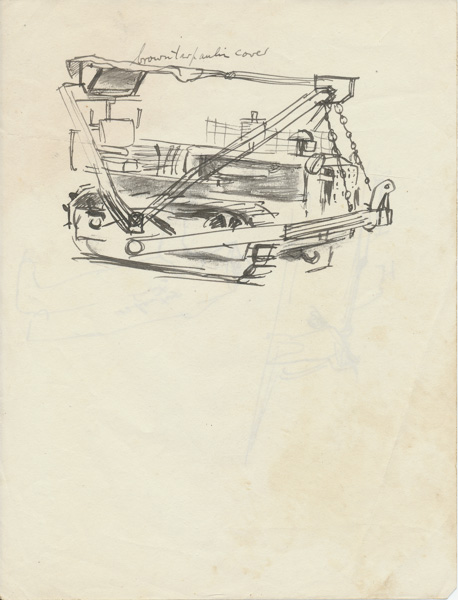
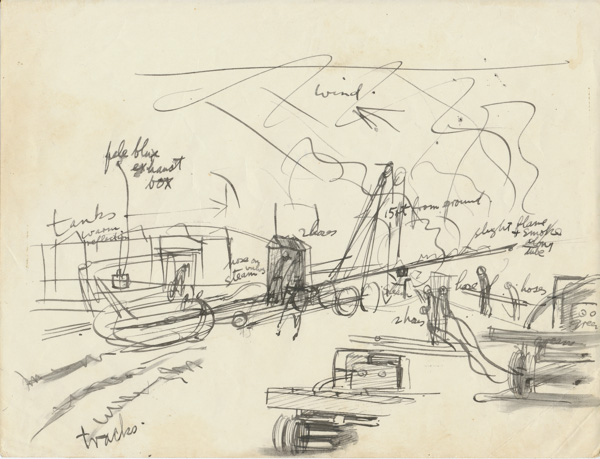
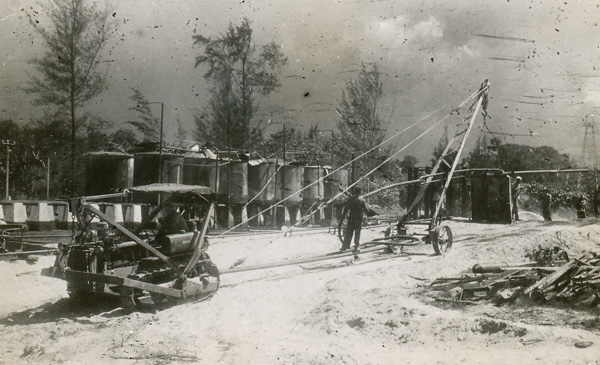
Australian engineers rig up a system to put out the oil fires at
Australian engineers rig up a system to put out the oil fires at Seria using a bulldozer rigged up with steam jet
Australian engineers rig up a system to put out the oil fires at
Australian engineers rig up a system to put out the oil fires at Seria using a bulldozer rigged up with steam jet
Australian engineers rig up a system to put out the oil fires at
Australian engineers rig up a system to put out the oil fires at Seria using a bulldozer rigged up with steam jet
Australian engineers rig up a system to put out the oil fires at
Australian engineers rig up a system to put out the oil fires at Seria using a bulldozer rigged up with steam jet
Australian engineers rig up a system to put out the oil fires at
Australian engineers rig up a system to put out the oil fires at Seria using a bulldozer rigged up with steam jet
Australian engineers rig up a system to put out the oil fires at
Australian engineers rig up a system to put out the oil fires at Seria using a bulldozer rigged up with steam jet


[Study for Burning oil wells at Seria II][Study for Burning oil wells at Seria III]Oil wells at Seria set alight by the Japanese before departing

21 x 11 cm 21 x 11 cm Oil wells at Seria set alight by the Japanese before departingBurning oil wells at Seria Oil wells at Seria set alight by the Japanese before departing

War Letters – Borneo: 24 July 1945, Brunei; Afternoon tea with the local villagers

Brunei
W.E. Pidgeon
C/o Public Relations
1 Aust Corps
Tuesday night
24 July


My dear Jess,

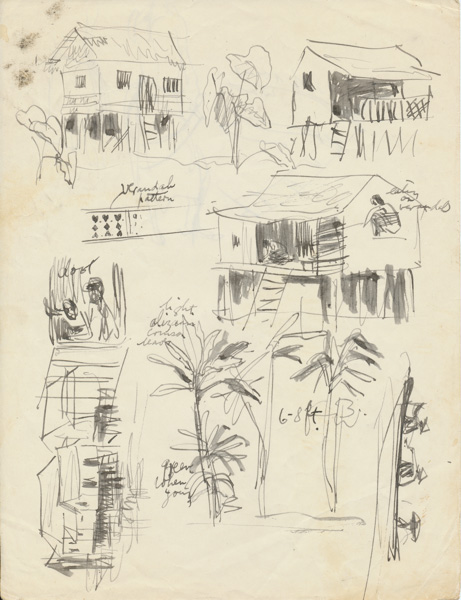
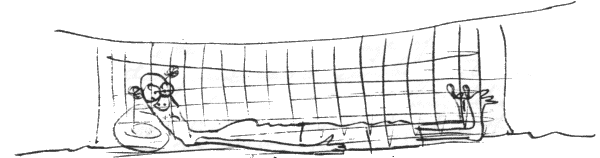
Am now on the mainland of Borneo and am camped at a spot by the river about 1/2 mile out of what is left of the village of Brunei.  I remember seeing an article on the leader page of  ‘The Herald’ in which this joint was described as the ‘Venice of the east’.  If Venice is anything like this God help it!  On the opposite side of the river there must be a couple of hundred native houses built over the water & supported by timbers much the same as the Papuan houses around Moresby.  There is an incessant coming & going of small boats – in & out from the houses, up and down the river – all over the bleeding place.  These houses look drearily squalid but the touch of tropic romance (sic) is supplied by a group of young kids paddling & singing a queer Malayan song which carries well across the water.  A slithering sound & a rasping of dry grass makes me jump & consider horrific images of pythons crushing Willie’s bones.  I escape this pulpy fate & sigh to see a lizard of the brightest cutest green imaginable and he eyes me obliquely & unmovingly.  After time I’ll take without a qualm the pinkest of elephants.  Maybe it was the gin I had last night.

I am escorted by an intrepid bodyguard from the Public Relations.  Apparently his job is to arrange transport for me and to fight off the Japs while I pursue the arts and further the successes of the “Women’s Weekly”.

It took us 4 1/2 hours to cross from Labuan.  After a large trip like this and a modest suggestion of a hangover I would willingly have given Borneo back to the wild men.

Had a bit of a snooze just before tea which is at 5.30 pm.  Incidentally the time the army is operating on is all haywire. I reckon it is about 1 1/2 hours ahead of what it should be.  This close to the equator one must expect normally sunrise about 6 am and sunset about 6 pm.  As it is sunup is nearer 7.30 am than anything and it gets dark at 8.  All this guff merely to tell you we have tea really at about 4 pm.

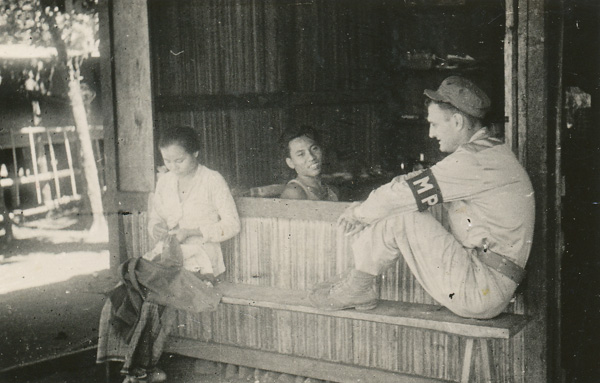
MP escort on a visit to the village at Brunei
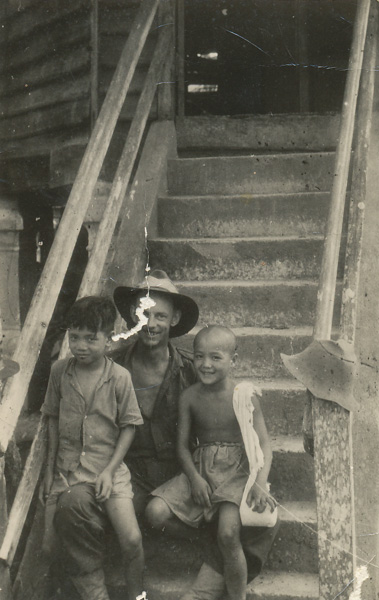
Wep with some local children, most likely in Brunei

Went over the village (the part that is sensibly built on land) after tea.  Accompanied by an army cop who talked and explained all the doings like a cook’s tour spruiker.  Had two cups of tea in a native home – this palace was underneath the house proper and in the room which I would say was approx. 15′ x 15′ lives 4 couples & an uncountable number of children.  These natives sure know how to reproduce the young.  The provost fellow knew a few words of Malay and all was giggles & tea swilling.  The higher social level here is maintained by the Chinese of whom some are really good lookers.  Many of them are pretty wealthy and live in large & airy homes bounded by gracious tress, bamboos, & banana plants.  Basically it is an interesting enough place although now sadly in need of repair & paint since the Japanese occupation.  The natives here are hard bargainers and see to it that the army boys pay plenty for what they want in the way of souvenirs.  Saw some magnificent sarongs some of the lads had paid 50 dollars for.  50 dollars to you mug, is about £7.10.0.  Quite a whack!

There’s a bug of some sort creeping round here making noises just like dear old Joe Palooka’s “Tch, Tch”.

Some of the little native kids are delightful.  I’d like to buy one for little Graham.  They carry on with the same antics.

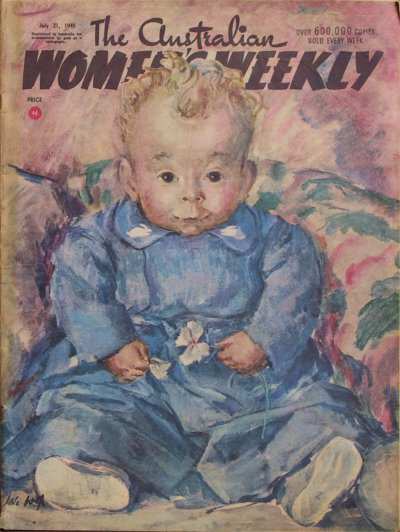
Little Wep; The Australian Women's Weekly, 21 Jul 1945
Little Wep; The Australian Women’s Weekly, 21 Jul 1945

Jimmy Smyth’s wife posted him the cover with our little man on it.  I look at it lovingly & it is now travelling Brunei State with me.  Is he looking after you all right?

I think I’ll push off to bed as I’m all wore out.  My salubrious couch consists of a hip hole in the earth – a ground sheet, a blanket, and a mosquito net.

Yours for better sleeping – loving Will.

Image11

8.30 am Wed.  The Brunei ground takes the fun for hardness.  It all added up to the longest night I think I’ve ever spent.  At last I have achieved a measure of benevolent dignity.  Graciously I acknowledge the salutes of the astute and discerning natives.  I walk along bowing & beaming like Queen Elizabeth.  The natives are nuts on gold teeth.  One soldier here told of a Malayan who had all his teeth covered & leaving a heart shaped window in the gold in the front – “Very pretty it was too”, says the boy.  I’ll bet?


Image12

Smart effect that

Lots of love darling to you & Graham

Bill

War Letters – Borneo: 25 June 1945, Sydney; Request for permission to travel

Brigadier J. Rassmussen,

Director General Public Relations,

L.H.Q.,

MELBOURNE. VICTORIA.


June 25, 1945

Dear Brigadier Rassmussen,

We are anxious to send our artist, W.E. Pidgeon – (Wep), to Borneo to do a series of paintings and black and white pictures for us.

Wep went to New Guinea for us and produced a number of pictures which we published in our issue of June 10, 1944. In January of this year he went to Morotai under the auspices of the R.A.A.F. and the results of his work appeared in our special R.A.A.F. issue on April 21, 1945.

I should be glad if you would let me know as soon as possible whether we have your permission to send him. I understand he has had all the necessary inoculations.

Yours faithfully,

Kenneth Wilkinson.

Acting Editor.

Caravanning with WEP – Winter, 1938; a week at Jindabyne with Lennie Lower


In the 1930s, Lennie Lower was considered one of Australia’s foremost humorists. His novel, Here’s Luck was first published in 1930 and is considered a classic of Australian humour.  It has been reprinted many times since and was illustrated by his good friend and colleague, Wep with the 1955 edition.  Wep and Lower were closely associated from the time Wep first started illustrating his column at the Daily Guardian in Sydney and later at The Australian Women’s Weekly when that publication commenced in 1933 cementing their notoriety throughout Australia.

Lower was reknowned for his drinking and in the winter of 1938, Wep and his wife Jess were accompanied by Lower for a week’s sojourn in the Snowy Mountains region around Jindabyne and Cooma.  Lower was to write a series of columns for the Daily Telegraph and Wep was under instructions not to give Lower any more money than 2 shillings.  Lower went to Cooma with his two shillings and returned rotten drunk with seven and sixpence change. He’d gone into Cooma and told everyone who he was, and that he was there with Wep. No one would let him pay for a drink and actually pressed money on him thus defeating the other instruction to Wep to “sober him up and keep him sober.”

War Letters Back Home – from Northern Australia, Papua New Guinea, Morotai and Borneo

During WW2, William Edwin Pidgeon (Wep) was a War Correspondent for The Australian Women’s Weekly. Between 1943 and 1945, Bill was attached to the Australian troops in Northern Australia, Papua New Guinea, Borneo and Morotai where he was situated when hostilities ceased in August 1945. In his work he recorded the daily lives of the men, women and natives around the camps, field hospitals, race meetings, church parades and some famous battle scenes. As a participant in their lives he drew and painted his subjects with a marked sense of involvement and an unmistakably Australian feeling of casualness. There is no straining after effect in his compositions, which are almost always of groups of figures in their appropriate settings. Their style is quite opposite to the style of the official war artist’s portrayal of troops in heroic action. The paintings are usually small in size, with a limited colour palette and restricted by what material was available on the run.

The following is a collection of letters to his wife, Jess, during these trips; letters composed in similar vein to his painting, yet full of visual verbal description describing life amongst the troops complete with illustrations scattered throughout.

Caravanning with Wep – Tuesday, 1st June 1937; Jindabyne and the excitement of first snow fall.

Campsite covered in snow

1st June

Patience rewarded. A biting wind all yesterday. Later, drizzle the noise of which ceased about 8 o’clock and a quiet murmurous warmth pervades the air. Jess goes out into the night for something or other, yells excitedly “Snow”. Instant excitement replaces sleepy boredom of work-doing. The “W. Weekly” strip pushed brusquely aside while I goggle & stare at the fat and sloshy falling snow. Great wet flakes defy expectations by falling noiselessly instead of splodging plunklyly. We run out with the lantern dancing in the whiteness. The alive quietness broken only by the sharp hiss of melting flake against the lamp. A curious velvety warmth replaces the chillness of the day. The heavens cloak the naked earth. We hasten to sleep so as to wake wide eyed upon an accomplished fact. 5 o’clock comes but the snow has been replaced by rain washing off the clinging whiteness. By 6:30 2 inches of snow still covers the land & has within the hours changed all colour. The country is hardly recognisable. Trees and fences are etched sharply against the paper white. Bewildered cattle and sheep nose in the damp seeking the grass that is hidden now from view. Three weeks calves, damp hided and amazed, bawl lustily for their parent’s comfort.

Dawn surveys the morning scene

We try to ski round the confined & grade less vicinity of the caravan. Hopeless endeavour. Dawnie stands in the caravan desolate & shivering. It is beyond her cognisance. We inveigle her out. She scampers & slips and bites the points of our skis. My low feeling disperses and we decide on Kosciusko. An early feed of soup and away. Chains are needed along the road & much to my rising annoyance are too big and flap madly against the mud guards. After two attempts I more or less remedy the trouble and re-enter the car with half the road on my arms and face.

Did a spot of skiing up near the Koscy on a down trodden practice ground. Elsewhere unreliable snow crusted over dangerous softness. Afternoon tea & home to sausages and eggs. The sky surprisingly variegated against the paling whiteness of the snow, blue then salmon then orange, reverting again to blue. Livid clouds smear the horizon. Cold! Return to snow less caravan. Feels like a hearty frost tonight.

George Longmuir came out over the week end & a good time was had by all. Took him up to snow less Kosciusko. Boiled twice on the way. Ate hearty on mixed grill. Billy of milk floated leisurely downstream during our absence.

(Margin note: Carl & Red dressed in everything but the hotel eiderdown.)

error: Content is protected !!