I’m out at a military hospital waiting for results of a malaria test. Everyone going north has to have a Malaria free certificate.
Arrived here at 1.15 after a pleasant trip. When we got to ANA office in Brisbane I left my gear & reported to the Public Relations people where I had to get a further pass & have arrangements made for transport further on. So far as I know I’m leaving Monday.
Contacted Hughie Dash, Telegraph representative here. He took me round, got me accommodation at a PRIVATE hotel. When I returned to pick up the luggage – the blasted kit bag was missing. One of the girls seemed to think it a great joke that she had seen a soldier take it out. Christ! Was I mortified! Panic swept over me like a steamroller. Your heart would have bled for me. The manager was a little more civilized & suggested it may have been picked up by mistake. So he started ringing all the military folk who were on the plane. None of them had it. At 6.30 pm I staggered down to the Police & reported. Tottered back to the ANA & at 7 pm the bloody thing turned up! A RAAF driver had taken it in mistake. I’d have got drunk if there was anything to drink in this God-damned dry joint. The beer here just ‘aint! It’s only for ½ hour midday and again from 4.45 pm to 5.15 pm. A seething screaming mob of soldiers and civilians battle grimly for a smell of what’s going. Most of them only get a look at it. Hugh Dash, Ian Gall, cartoonist and Roy Connolly, (of Colin Wills wife fame) & I managed to get 4 beers & 3 rums between 2 pubs. Grog was then over.
Brisbane is a hell of a lot busier than Sydney. Streets are jammed with cars and people. Vast vistas of squealing yanks open before the eyes. The place is lousy with them. At night the city is scarcely less infested than in day. S’Awful! Everybody gapes at my green armbands – most embarrassing – one hears – “Big Shots!”, “General Staff” etc. Mortifying! All the others have learnt from experience to wear inconspicuous metal badges. The correspondents life is not a happy one!
STOP PRESS
Am leaving for Darwin at tremendously early hour as appointed. Lots of love, be good and give me some kind thoughts – love
Proust could have done it. He would have remembered every taste of boiled swedes, or cheap oatmeal he had from the days before he even would accept a cup of tea. All the awful healthy flavours which were not in the race with lemonade and marshmallows.
Sometimes when the leaden soldiers were not battling well my brother and I would have a go at peanut brittle, Bulgarian Rock or even marshmallows. Most of our efforts were not worth keeping, although peanut brittle & Bulgarian Rock were hard to dispose of. They had an indestructibility that even our scones lacked.
Mother was probably collecting the rents or playing bridge. She accepted our beginnings of haute-cuisine with a great deal of grace – so long as we consumed or gave away the delights and washed up after the mess.
We didn’t seem to be pushed around too much to household chores – maybe we kept to a minimal area – easy to clean.
Yet it was laid down that on Sunday morning, mother was taken tea and toast to her bed three floors up where she read the papers in luxurious ease. Occasionally she would borrow a “Truth” which would be hidden under a cushion later.
On the way back from Union Street the warmth of the meal tucked under my armpit released urges which the smell of chips rendered irresistible. I never knew how many chips I pilfered on the way home from the newspaper bundle. Doubtless the greasy paper contained the latest news of the attack on Passchendaele or Gallipoli for all I bloody well knew – or cared.
Somewhere just down from King’s the chemist, was an empty house which should have been haunted, but was not. It was cracked and all the cracks weren’t just the hairline things you see in the footling little walls people build these days. These cracks had the nobility and the vigour of the Mississippi River network. From the front gate which had even then long since been locked into rusted immobility, it was never used, seeing that there was no fence attached to it and one really did not have to open the gate to an estate which was not inhabited, anyway.
From the locked gate, locked so irrevocably that even St. Peter could not have opened it against the sole remaining erstwhile staunchness of the fence its opposite style member had parted with the things in it. It spread the non-fence demarcated by chick weed and pee-the-bed.
Am I still alive in Paddington? I have lost the contact. The stream of sub-consciousness is receding from awareness. – I am not remembering – I am not helping my childhood or my sons. If I put it down, it is out of my system, – the agonies, fixed – classified, not to be endured again, exhibits. That much of the effort sucked from the memory – one less thing in the bucket.
What in that crazed house must be written down and commented upon from the memory of our blood? Windows awry, concrete cornucopias adrift from the brave façade.
Sunflowers growing through the gasbox and behind the windows a suggestion of life becomes sometimes the grey sun drapes were not so fixed as there had been a week before. In the garden the long johns wart bent and withered in its maturity: the paspalum only just held its own with the buffalo because Glenmore road was kind in buffalo and greeted it. It grew in such great clusters as only a motormower salesman could envisage. Not that it was in any danger then, for the only pair of hand shears within blocks was regularly borrowed for the necessary training of the tiny lawns at Waverley Cemetery, wherewith monstrous regularity, our neighbours made their abode.
I’ve had this house – It hasn’t come to life—I have started off to say something and it has died in my throat. I don’t like that house now – It is not amusing, and if I think of it, I feel pretty near like it looked. Some other day we will both go down to Glenmore Road and throw a stone at its memory.
You, that is if you were under forty and were a guest at my grandfather’s table, were not allowed to laugh outright or for that matter, even giggle. If you were under thirty you had to wear the mask of a sphinx no matter what clean clerical joke was cracked.
It always seemed a little odd to me that on the seventh day there had to less humanity in the house than there was on the other six. Not that is to say that there was much fun and games for the young from Monday at 1 am (if you were up) till Saturday 12 mid. during the week. It was just that if you felt like smiling on the sabbath you just daren’t.
Bill and Jack Pidgeon in the backyard of their home at 290 Glenmore Rd, Paddington, c.1915
Grandma who always wore a great collar which was distinguished by its height and purity of whale boned lace, always saw fit to give my brother a good clip under the ear whenever he passed. Why Jack never learnt to pass her underneath the table or beneath the throne she held court on is still beyond me. Not that Jack did anything very much. Being four years older than I, he couldn’t sense the danger of just being around. I suppose his Eton collar and the fact that he sang in the choir sort of gave him (falsely in his own view) an air of sanctity which Grandma always failed to discern.
The clips on the ear Jack always earned for the little things he might have done or even thought of doing, but never had the hardihood to do. For the things I would have liked to do Jack got two clips.
So it was that Jack always smothered up in a neutral corner when Grandma was around.
Grandpa was beyond all this. He just sat and ate and ate and bemoaned his lack of appetite.
His theatrical indifference to food never seemed to dim his awareness of what was going on or off the plates to the right and left of his august presence.
One dreadful 1st Sunday before Pentecost our hired help foolishly skidded her meat and peas on his lap.
If this girl ever had a name, that is immaterial. Today she is probably wrestling under the name of Big Chief Thunderplate or another latin alias. Although young, she had an extraordinarily powerful jaw which was never really clean shaven. The mole, which on another face would be called a beauty spot. remained untrimmed.
A few weeks after she tipped her Sunday dinner on the lap she went completely to pieces & either stayed out on a tram or sat on a gas box till 10 pm.
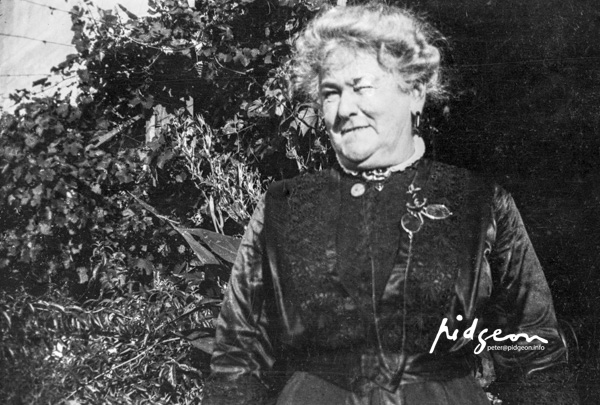
John White, Wep’s grandfather, c.1923 – born 1851 in East Looe, Cornwall, he was a Master Builder and former president of the Master Builders’ Association. He built many of the beautiful terrace buildings around Paddington including Paddington Town Hall. He served as an Alderman on Paddington Council from 1884-1913 and was elected Mayor in 1892. He was also the founder and first president of the Cornish Men’s Association.
I reckon that Grandpa was quite a character. He seemed always a bit like God to me. Not that his beard was over flowing and lustrous like the high cumulus that came over Taronga.
Grandpa always sat at the top of the table in the big kitchen and regularly complained about his lack of appetite.
Grandpa suffered no ills. Apart from lack of appetite which was cured at meal times – he suffered only the livings of cold weather. These afflict the ageing and the thin like me, the un-diesel heated, the Grandpas. I suppose it was really Isabella Garrick McRitchie, his dour Scots wife who had the nostrum for all ills. Her recipes for cold agues had the genius of simplicity.
Grandpa wore, what Grandma sewed. A two inch bandage of red flannel around each wrist. This was an infallible preventative against goose flesh and wintry shivers, and so far as Grandpa went it worked. We’d sit shivering over some bread and dripping and marvel over his pulse warmed vigour as his flashing crimson wrists downed with gusto a Scots Irish Stew.
I really think it was more a psychological matter thing than a good old viable commercial. Somewhere in the boggy ice ages Dracula had got to Scotland. The keen old biddies knew that if you had bloody looking red flannelled, medial tuberosities of the radius wrists – he’d be confused and drop you as a pass-over has-been, a very traumatic connection twice done-over somewhere about those thin blue veins on the inner sides of his wrists and consuming teeth.
It must have had something to do with the night he baby-sat me. God knows where Grandma was but I’m in the double bed with Grandpa paradisaically night shirted and me trendy in pyjamas. It was a handsome four posted cedar mausoleum with a horsehair mattress as soft as a concrete slab. Grandpa slept with the sonority of a Bach fugue.
I don’t know whether it was the austerity of repose or if dreams of vampires which woke me in terror. I felt I was being masticated or impaled with an oaken shaft. Awake, upright as the cold moonlight, my fears were resolved unheard.
It all came clear and simple in the cold light of the moon. Rationality triumphed, cause and effect were vindicated as I unhooked his dentures off my flesh and slid them gently back beneath his pillow.
I hadn’t expected that – mostly they sat overnight on the mantelpiece keeping a purposeful vigil from their tumbler full of water.
[W.E. Pidgeon]
John White, W.E. Pidgeon [c. 1927] Painted when Wep was 18, this is one of Wep’s earliest portraits.
WHITE .—The Relatives and Friends of Mr. JOHN WHITE, Master Builder, are kindly invited to attend the Funeral of his late beloved WIFE, Isabella Garrick, which will leave her late residence, “Trelawny”, Gurner-street, Paddington, THIS FRIDAY, at 3 p.m., for the Church of England Cemetery, Waverley. CHARLES KINSELA, Funeral Director, ‘Phone, Padd. 694., 143 Oxford-street. Sydney.
WHITE.—The Relatives and Friends of Mr. and Mrs. JOHN A. WHITE, EDWARD C. WHITE, HARRY F. WHITE, Mrs. T. J. PIDGEON, Mr. and Mrs. S. E. PATERSON are kindly invited to attend the Funeral of their late beloved MOTHER,- Isabella Garrick Whlte, which will leave her late residence, Trelawny, Gurner street, Paddington, THIS FRIDAY, at 3 p.m., for Church of England Cemetery, Waverley.
WHITE.—The Relatives and Friends of Mr. D. MCRITCHIE, Mr. ROBERT MCRITCHIE, Mrs. R. THEW, Mrs. F. CROWE, Mrs. J. MCRITCHIE, Mr. and Mrs. McLEAN, Mr. and Mrs. E. CARR. Mr. and Mrs. CAMEREAUX, Mr. ROBERT MACKEY, and Mr. JAMES MACKEY are kindly invited to attend the Funeral of their late beloved SISTER and AUNT, Isabella Garrick White, which will leave her late residence, Trelawny, Gurner-street, Paddington, THIS FRIDAY, at 3 p.m., for the Church of England Cemetery, Waverley.
WHITE.— September 18, 1924, at her late residence, “Trelawny,” Gurner Street, Paddington. Isabella Garrlck, dearly beloved wife of John White, and mother of William, Frederick, Thlrza, John, Edward, Harry, Percy, Isabella, and Blanche, aged 71 years.
Grandma was dead. It must have been in the morning sometime in December [sic] because I was given some money to go to the pantomime down at Tivoli. What the pantomime was about, or its name and its impact on me remains securely forgotten, rotting away in some remote and atrophied cell of the brain.
Amy Rochelle could have been the Principal Boy. Principal boys were always girls anyway and Amy Rochelle boarded with us once. So maybe a little boy was sent off to see the big girl boy he knew while the family went about the duties attendant to the proper care of the dead.
Funerals were always a big occasion in those days. Uncles, aunts, cousins, even down to the fourth remove would congregate at “Trelawny” while the men went off to do the right thing at Waverley Cemetery, the women busied themselves in the preparation of sandwiches, tea, fruit cake and the inevitable port wine to refresh the returning mourners.
Glasses of the ale too were served under the dancing shadows of the grape vine trellis to the convivial grievers.
All those garrulous relatives, complete strangers flushed out of obscurity by death mingled in monetary bonhomie and parted till death again did them join. I suppose there were extra trams on these great days – no one had a car.
It was 1924 when “Trelawny” first housed a motor vehicle.
Uncle Sep, a devastatingly handsome and successful dentist had married Aunty Bella. They lived at “Trelawny” and looked after Grandpa White.
Somewhere along the line, the old dray, the buggy and the mad town (carriage) had been sold to more rural folk. The old carriage house was taken over by the Dodge. Uncle Sep’s friends had successfully updated and hard-sold him into switching from trams to a car. I was appointed car-washer and mechanic. Like all young boys, I knew more about cars than it is possible to know. I was constantly tuning the engine from perfection to imperfection. If anything was right I’d fix it.
L-R: Bill’s mother Thirza Pidgeon (nee White), Bill Pidgeon (in car), Sep Paterson (Bill’s dentist uncle), Ted Paterson and his mother, Isabella Rose (nee White) and possibly Sep’s brother with Sep’s 1924 Dodge Brothers Four Door Tourer car
Still we used to go so far as Windsor or Katoomba at speeds of up to 45 mph and have picnics on the running board safe from bull ants and other bushland horrors.
I learnt to drive it like a kangarooish motion. All very safe for the streets were as vast and “unencumbered” as the only hazards on the Nullabor Plain.
[W.E. Pidgeon]
[In 1925, Wep was employed as a Cadet Newspaper Artist for the Evening News and Sunday News, after his dentist Uncle Sep “armed with forceps and needles ‘intimidated’ his patient”, editor of the paper, Marmion Dart.]
That tuck-shop and residence opposite the school gate has not changed its shape in sixty years. The weatherboards and the paint of what is left of it are still as they were when the Thomson widow ran it. Of course it had to all come back in a gush of memory. Nowhere else in recent years have I seen the small sunflower stretching in glory to the face of being. Only here in the weedy ground have I seen the remnants of old time proliferation of sunfire blaze. Everywhere, sunflowers bright like the burst of color of coreopsis in bloom along the north shore line.
Long ago, before Van Gogh made the big ones commonplace, we as small children would stare up to the swaying sol six feet above and with a face as big as a soup plate – bending over the fences to radiate a joy to small children in the shadows of the lanes. Sunflower and chokos over bore the tattered fences – the sunflowers were gay – we got sick of chokoes and chops. The little sunflower plants had leaves like the feel of a cat’s tongue, raspy on the skin the loving tactile semblance of a sedge tooth file.
There used to be the depths of night shaped into gramophone horns adorning the more neglected lanes. With our bited dogs we passed the convolvulus bells with siren tendrils clutching at our throats. In the twilight, the vibrant blue weeds of our back yards. I never remember ever seeing a frangipani or hibiscus or any other modern exotica. There were scents of the evening – perhaps we were too young to notice the small white jasmines or the occasional tuberoses. Red geraniums, yes everywhere in little window boxes – not children’s flowers at all – very adult.
Arum lilies and cannas yes (mostly around the semi detached) -seemed to lend a glory to the necessities of human functions.
Who was not enabled on the way back from the out-house by the soft lick of the lily leaves and a fairy touch brush across the face of the asparagus fern?
My Grandmother had grape vines which bore somewhat edible fruit. She had too, a sturdy clump of verbena shrub. Somehow this seemed to go along with her personality extremely well.
On Sunday afternoons after being let out of Sunday School we would aimlessly roam around the cabbage patch (fenced off of course) past the manure bin through the carriage paint shops (as those sheds were called) all mucky & soiled. A good fistful of verbena leaves crushed up in smelly hands. How those verbena leaves reminded me of Grandma.
Just like carraway seed cake. You’d have to have been born in 1860 to have acquired a taste for that. Sunday afternoon tea was a bloody trial. Carraway seed cake and Sao biscuits, or Thin Captain. Perhaps we were given lemonade – if we had been, the occasions have left no impact on my junior memories.
Only one other plant ever impressed me. Grandpapa’s glossy tree on the 3’ x 4’ lawn in front of “Trelawny”. Grandpapa used to sit on the gas bar during the dusk and note the comings and goings of the locals. Everyone was on foot just like in a communist city. This tree, or shrub, was not more than three times taller than I. Looking from underneath its leaves were dull and undistinguished but from the verandah they were miraculously transformed bright green and glossy as a cerebric glaze. It was a very formal affair & impressive but never to the day has it had a name or a signature of being. Perhaps it is still there – I should look again.
Trelawny (1896), 11 Gurner Street, the home of Wep’s grandfather, John White, master builder and Mayor of Paddington at the cnr Gurner and Duxford St Paddington, c.1920
From round Goodhope Street and down by McCaffrey’s (or was it Stoddard’s) place he would come in the settling mist. It was colder and darker in the early winter. We had ceased play, even old Warder had given up his dismal barking, his sniffing at the old cast-iron lampposts. Huddled in anticipation of the new world, we awaited his coming. Mr. – I cannot dredge up with name but to us, he was a real mister, almost a bishop.
His silhouette against the last gas lamp he had lighted, greater, closer and bigger in the full dusk – until he greeted his tiny congregation. With his crook he would pull on the light. Down Hoddle Street and up around to Lawson Street we followed. The admiring flock, the bishop of the young and the lighter up of the lamps existed only for our particular joy and wonderment.
Always the shadows marched east from Goodhope Street. It didn’t matter whether it was winter or summer, those shadows marked the creeping end of day, finally to engulf the short valley of Hoddle Street with twilight yet leaving to the last moment the repossession of the golden light on the school and the tips of the terraces on the odd side of Glenmore Road.
Sometimes we children were quick and naughty enough to anticipate the elderly lamp lighter – yet mostly we seemed to follow him in a religious rite of observance to his ritual motions of the crook which brought the gas to light on the corners of our territory. We followed the soft effulgent glows so far as Cascade Street and called the ceremony a day, or better speaking a night.
Crickets and cicadas gave the drone notes to our shrill childish cadenzas as we marched back to a wash and something hot to eat.
I first met Bill when I was a seventeen year old copy boy in the artist room at the Sydney Daily Telegraph in 1944. He had just returned from New Guinea and I was greatly in awe of him. I had seen his work long before (my father had worked in the publishing rooms of various papers and always brought copies home – the Telegraph, Smith’s Weekly, Women’s Weekly, etc) so I was familiar with his comic illustrations. What I now discovered was his immense versatility in the war paintings he did.
He was probably the first adult I was encouraged to call by his first name. At his insistence he was either Bill or Billy Wep or Bill Pidge. Everyone else was Mr. or Sir. He was very warm, friendly, encouraging and funny.
He had a reputation for heavy drinking being among those that appeared in the pub when they opened at 10a.m.. What very few knew was that he’d already worked six hours, rising at 4a.m.. Newspapers were pretty boozy places anyway so the reputation did him no harm.
I didn’t know Jess at all as she was very sick but I heard a lot about her from his friends and colleagues. I know he adored her and that she was strikingly good looking and that he adored her not only for that but for her spirit and all the qualities she had and shared with others. He nursed her until her tragic death.
He used to come to the Artist’s room to get pencils, ink, white poster colour and paper but would always look at what I was drawing and say things like ‘that’s very funny, do more like that’ or show me the books of the old masters. I remember him showing me a book of Hokusai the Japanese 18th century print maker and telling me that he signed his work ‘An old man mad about drawing’. Bill thought that was marvelous.
Bill would appear always wearing a pork pie hat, always well dressed in a casual way. He had a soft voice, workman like hands with solid blunt fingers (as I well remember, from having one of them down my throat to make me up-chuck some of the excess liquor I’d consumed at the Artists’ Ball so I’d be sober enough to drive home.)
He was great encourager of young talent, Brett Whiteley, Peter Harrigan and me. He even set up a travelling scholarship which I was told later he meant for me but I was in the Army in Japan and madly in love with an American girl and didn’t enter. Peter Harrigan did and deservedly won a year in London. I think he was so in love with drawing and painting and just creating with his hands that when he saw talent in others he couldn’t help but foster and encourage. I remember him showing me a short flight of concrete steps at Northwood. He was so proud of having made them that he signed them Wep.
His friends Geoff Turton, George Finey, Bill Mahony and others told me stories about him shocking a posh dinner party with an oyster stuck in his nostril waggling about. About him taking Lennie Lower away to the Snowy Mountains with instructions not to give Lower any more money than two shillings (20c). Lower went to Cooma with his two shillings and came back rotten drunk with seven and sixpence change. He’d gone into Cooma, told everyone who he was and that he was there with Wep so no-one would let him pay for a drink and actually pressed money on him thus defeating the other instruction ‘sober him up and keep him sober’.
I saw a lot of your father when he was cartooning for the ‘Sunday Tele’ as I was rostered on on Saturdays. We used to drink in the Windsor hotel in Castlereagh St. He had his paper on the bar marking stories that might give him an idea for a cartoon. We’d go back to the canteen for a cold pork sandwich and he’d buy a bottle of dry sherry to share with the women in the Social dept. next door to our rooms.
Ure Smith the publisher got me to design the cover for ‘They’re A Weird Mob’ which I did but came down with appendicitis. Ure Smith asked Bill to illustrate it which was a bit much as he was trying to break away from illustration for serious portraiture and in fact had won his first Archibald [not at that time – 1957]. I think it was when he and your mother were either courting or had just married. I know he visited me in hospital to tell me he would do it. I only mention it because when the book launch was held, the author John O’Grady, a XXXX man at best, made his speech he hoped “You all made enough out of my talents to buy a new suit of clothes.” This was greeted by us all in stunned silence until someone announced that Bill had won his second [actually his first] Archibald. O’Grady was lost in the cheers that went up. O’Grady was very put out.
I met your mother several times both before and after marriage and have fond memories of her.